
Stolen Stories, Hidden Faces:
On Horror, Accountability, and the Long Shadow of Stolen Tongues

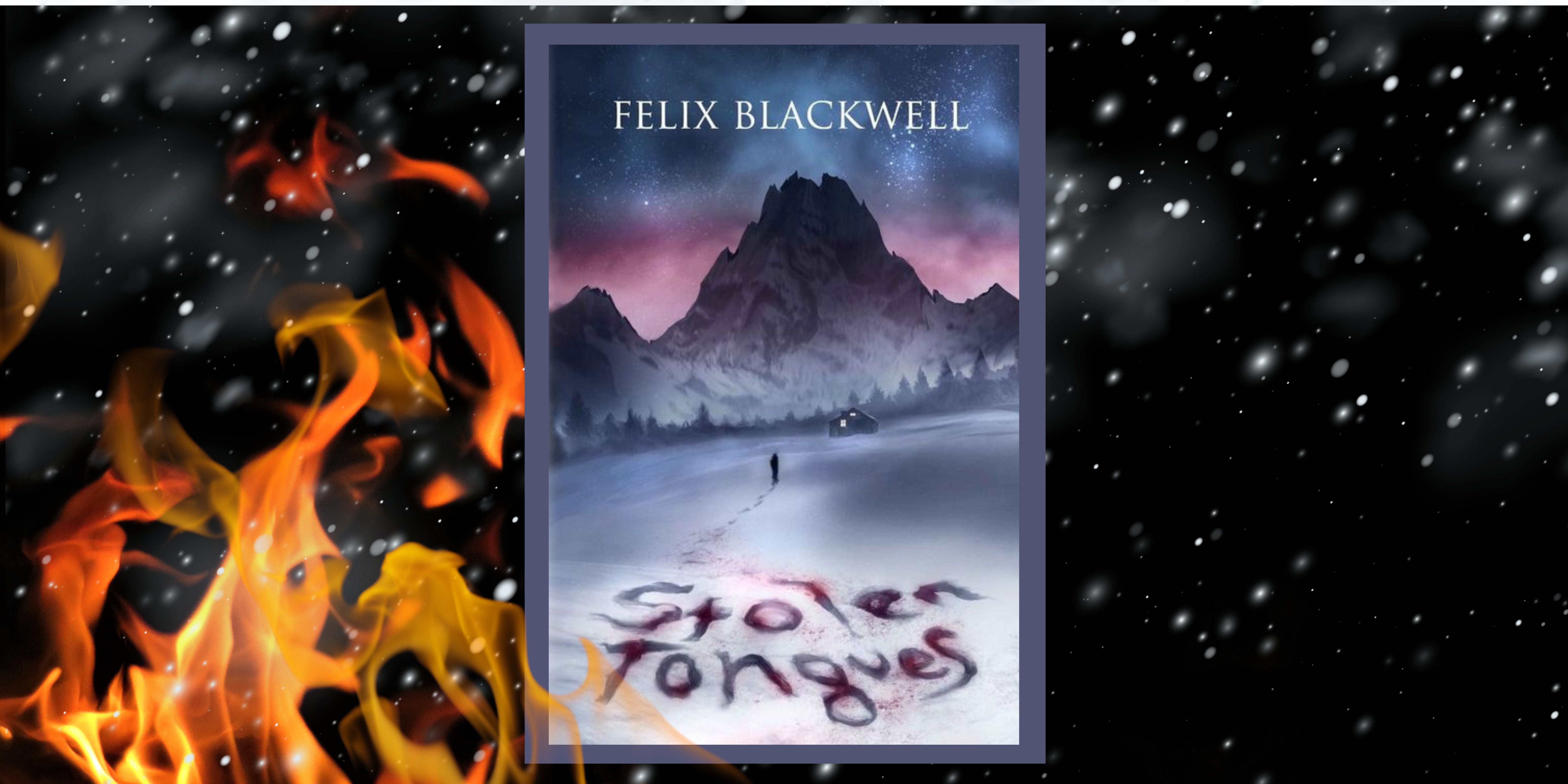
If you scroll through the Books of Horror Facebook group or HorrorBookTok for long enough, you’re bound to see a recurring image: fans proudly clutching copies of Stolen Tongues by Felix Blackwell, a book that’s become something of a viral rite of passage for readers new to indie horror.
But one image that recently surfaced tells a different story.
In it, Blackwell stands between two fans at an event—but instead of smiling at the camera, he holds his book in front of his face. Not out of irony. Not for branding. But because he asked attendees not to post any photos of his face online. Those who had already shared pics were later asked to blur or crop him out.
On the surface, it's a request for privacy. But in the broader context of this book’s history—and its long trail of criticism around race, appropriation, and representation—it reads less like boundary-setting and more like avoidance.
You can’t sell fear while hiding from consequences. And in the case of Stolen Tongues, the real horror isn’t what’s lurking outside the cabin window. It’s the way this book cannibalizes Native traditions while tiptoeing around accountability.
How I First Encountered Stolen Tongues
When I first read Stolen Tongues, I went in open-minded. I’d seen the praise. I’d seen the reviews. The book had jumped from Reddit NoSleep stardom to Amazon bestseller and even earned a movie deal. I wanted to like it.
And at first, I kind of did. The opening scenes—eerie noises in the woods, a sleep-talking fiancée, an isolated mountain retreat—are tightly executed. But the deeper I read, the colder I felt. Not the good kind of cold. Not creeping dread. But the kind that comes when you realize a story is borrowing cultural aesthetics without care.
What starts as a creepy cabin-in-the-woods yarn soon veers into well-worn territory: Indigenous spirits, sacred necklaces, cryptic sage rituals, and two Native characters who, of course, die offscreen in acts of self-sacrifice.
This isn't new ground. This is Poltergeist without the subversion. It’s The Lone Ranger in horror makeup.
Shortly after I published my original review of Stolen Tongues, I received a message from another indie horror author. They wrote:
“Glad I’m not the only one who thought it was terrible… I also wrote a scathing review. Lol.”
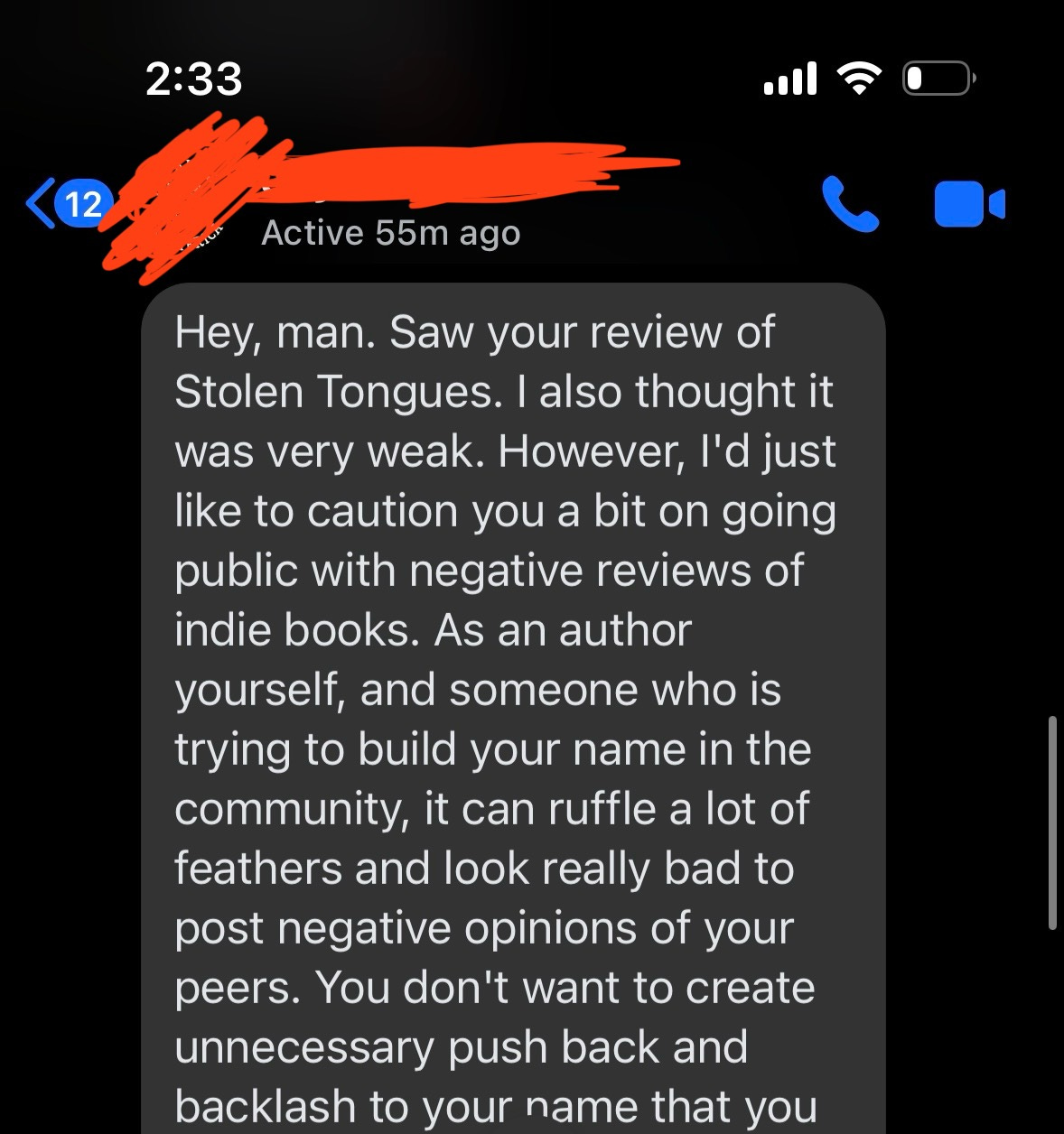
But then came the real point. As they added:
“As an author yourself… it can ruffle a lot of feathers and look really bad to post negative opinions of your peers. Trust me.”
He wasn’t warning me about Felix Blackwell himself—but about his fans, about other authors, about the invisible network of polite silence that so often masquerades as professionalism in the indie horror community. His advice? Take it down. Stay quiet. Don’t get a “reputation.” And embarrassingly, I did.
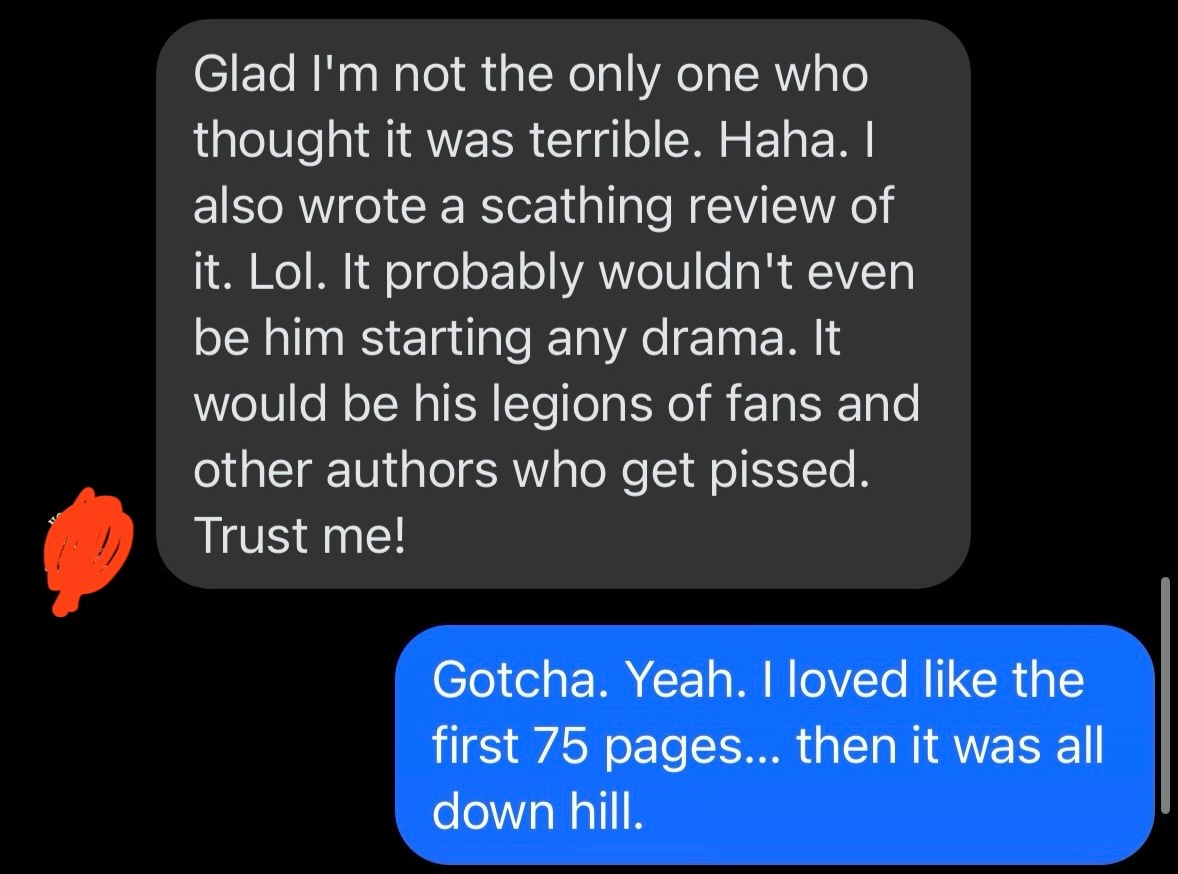
That message has haunted me ever since, not because it hurt my feelings, but because it perfectly illustrates the exact culture that let Stolen Tongues thrive unchallenged: one where it’s safer to whisper your truth in DMs than to speak it out loud. One where the fear of drama outweighs the responsibility to critique harm, even when that harm is wrapped in bestsellers and glowing BookTok hype.
And, embarrassingly, I listened. I took it down. I buried the critique that still lives in my chest—and my drafts.
The Invented Tribe Trick
In the book’s appendix, Blackwell attempts to inoculate himself from criticism by explaining his decision to invent a fictional tribe. He claims it was to avoid misrepresenting real Native groups. But anyone familiar with horror’s history of colonial tropes knows this maneuver well. It’s the “safe” way to keep the spooky aesthetic without the cultural accountability.
The result? A group of Native characters who function as spiritual advisors, plot movers, and eventual corpses—without ever being real people. The white protagonist (who is also named Felix) is the only voice we hear. His fiancée, Faye, sleepwalks through the novel both literally and figuratively. The Native characters exist to explain, guide, and ultimately die—so the white characters can live.
And then, in a kind of narrative Band-Aid, the protagonist promises to visit the tribe and donate to their community. You know—the fictional one. As if that resolves the narrative debt.
It’s white saviorism in ghostface.
Felix Responds (Sort Of)
Nine months ago, Felix Blackwell posted a lengthy, and admittedly, thoughtful Reddit reflection on Stolen Tongues and its backlash. In it, he admits what many already knew or suspected: the book was never meant to be a novel. It was a Reddit serial, written in real time during a low point in grad school. He self-published it without an editor, without craft training, without really understanding character development or cultural representation. And then it exploded.
The post is self-aware and emotionally complex. Blackwell recognizes the book’s flaws. He owns the rushed prose, the flat characters, and his lack of understanding around how to write women or Indigenous people. He even confesses that part of him wants to unpublish it—but he can’t. The royalties support his chronic illness. The book is still his top seller. He is, by his own admission, financially entangled with a piece of work he no longer fully stands by.
It’s honest. It’s nuanced. And yet… it still sidesteps the core issue.
Because despite all the reflection, the Reddit post circles the same defensive logic: I didn’t mean harm. I had a Native friend. I just wanted to scare people.
That may all be true. But intent doesn’t erase impact.
You Can’t Be Invisible and Infallible
And so we come back to the face. The hidden face. The author who wants to be present at events, to sign books, to receive praise, to pose for photos—but not to be seen.
This is where horror, fandom, and parasocial culture collide. Felix Blackwell wants to preserve the benefits of visibility without the risks. He wants to remain a figurehead while evading the complicated conversation his work ignited.
But horror is a genre built on confrontation. You don’t get to hide from the monster if you made it. You don’t get to drape yourself in Indigenous mythos and then duck when people ask where it came from.
And readers? We have to stop mistaking viral success for ethical storytelling. A book can sell well and still cause harm. A writer can reflect publicly and still get things wrong.
A Better Ending?
To his credit, Blackwell tried to grow. His prequel, The Church Beneath the Roots, features Indigenous protagonists, research-informed depictions of reservation life in the 1960s, and multiple sensitivity readers. It’s a course correction in many ways. But even he admits that writing to appease critics nearly broke him.
I respect that effort. I really do.
But I also think it matters that the book that paid his bills—the one that catapulted him to success—is the one that leaned on the oldest tropes in the horror playbook.
So maybe the real horror in Stolen Tongues isn’t the entity outside the window.
Maybe it’s the industry that rewards viral mimicry over cultural care. Maybe it’s the fear writers have of saying, “I was wrong.” Maybe it’s how we all get a little too comfortable with fiction that turns trauma into trope.
Final Thoughts
Felix Blackwell has every right to privacy. But when your face is hidden and your work is everywhere, readers will ask questions. We should ask questions.
You don’t get to borrow from culture and stay unaccountable.
You don’t get to profit from trauma and ghost your critics.
And you don’t get to call yourself a horror writer if the thing you’re most afraid of is being seen.
Want to Read Indigenous Horror Done Right?
If this conversation has you thinking more critically about how horror treats Native characters and folklore, I encourage you to check out works by Indigenous horror authors whose stories don’t borrow the myth—they build from lived memory and cultural survival. A few places to start:
Stephen Graham Jones – The Only Good Indians, Don’t Fear the Reaper, My Heart is a Chainsaw, and most recently, The Buffalo Hunter Hunter.
Erika T. Wurth – White Horse & The Haunting of Room 904
Rebecca Roanhorse – Trail of Lightning
Cherie Dimaline – Empire of Wild, The Marrow Thieves
Shane Hawk – Anoka, Never Whistle at Night (editor)
This isn't a “read these instead” list. It’s a read these too list. Because horror doesn't have to steal to scare you.